20255.13
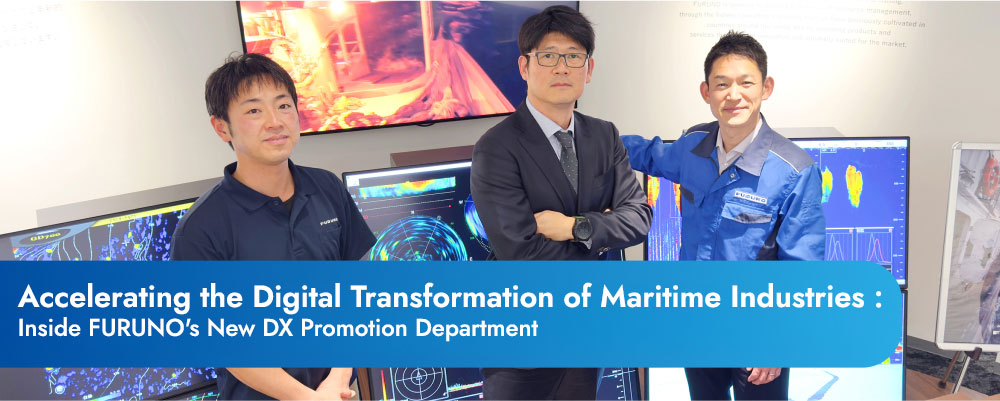
Instead of working in separate silos, teams are now sharing ideas, building faster, and tackling ocean‑industry challenges together with one objective: accelerating the digital transformation of the ocean.


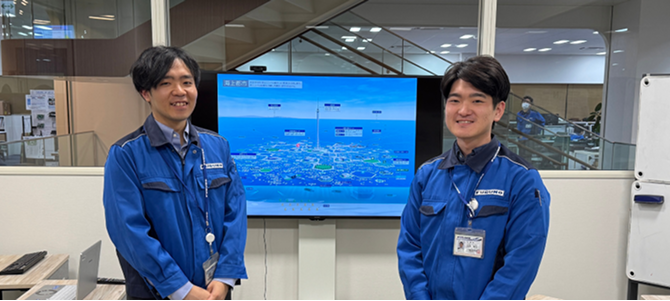
On March 1, 2025, FURUNO launched the new DX Promotion Department. Previously, the separate departments covering marine transport, fishing, and fish farming were each advancing with their own DX (digital transformation) efforts. Now, those initiatives have all been unified under one department. We spoke with three employees about the aims and vision for this new department.
Contents
- What is DX promotion, and why is a DX department important?
- Accelerating cloud service development with this new department launch
- Safe autonomous navigation will open up new vistas for the future of marine transport
- Changing work conditions within the fishing industry with stationary net monitoring
- Leading DX collaboration and energizing the entire industry
What is DX promotion, and why is a DX department important?
What kinds of things does the DX Promotion Department do?
Kitamura: We plan and develop cloud and application services to support the DX of customer operations. In the past, each of our separate divisions, like marine transport and fishing, developed their own DX technology. Now, we have gathered those capabilities into the DX Promotion Department.
Both markets and customers differ widely between marine transport and the fishing industry. In the past, most development attempts were taken on separately, but there are many similarities in the fundamental technologies of DX, such as system development for cloud development and operation. If we proceed as a single, unified department, there are many areas where we can work together, and we can accelerate development speed.
How have things gone since you launched?
Kojima: Not much time has passed since we started up, so concrete results have yet to take form. But one large advantage we can already see is that representatives in charge of new projects who were once engaging in development separately are now able to exchange information easily because they are all in the same office. They discovered that they are taking on very similar tasks, and have started to see all sorts of areas where they can move forward together.
Hazama: The fishing business area targets a primary sector industry, whereas the marine transport business area deals mainly with merchant ships, and their markets are completely different. But this is exactly why these areas can learn from each other's ways of doing business. They both share the goal of providing optimal services and products to customers, so I feel like everyone has more options in how to achieve their goals after learning how other departments operate.

Accelerating cloud service development with this new department launch
──Why are you focusing on cloud and application service development now?
Hazama: The fact is, Ocean DX is lagging dramatically behind land DX. Ships have only had the ability to connect to the internet at any time, supported by a satellite communications environment, since around 2010. So that was essentially the starting point for Ocean DX.
On the other hand, the fishing industry is accumulating massive amount of analyzable data. Everyone in the industry felt that it was a waste that, although all sorts of fishing ships are constantly operating in the seas with the capability to gather diverse kinds of data, that data was not being used. I feel like, with the infrastructure and technology finally supporting us, now is the time to do what we've always wanted to do.
Kojima: And in marine transport, gathering and analyzing data is definitely essential for reducing fuel, handling mechanical failures, and assessing and reducing CO2 gas emissions.
Additionally, it takes a lot of people to operate a large merchant ship. The navigators on the ship are in frequent communication with staff stationed in landside offices, and there are nautical instruments from many different companies onboard. There are many stakeholders involved, including shipbuilding companies, insurance companies, the ship owner, and vessel operating common carriers.
When trouble breaks out in these conditions, a system is needed that can collect data and share it in real time in order to speedily investigate the cause and recover functionality. In order to make this kind of thing a reality, we want to develop and use brand new technology that is created through a process in which we handle the collection of data in the cloud and use it with assistance from companies that specialize in performing analysis and simulations on the data.

Safe autonomous navigation will open up new vistas for the future of marine transport
──What can we expect to see in the future through marine transport DX?
Kojima: I think that first, we can realize safe marine operation by reducing human error through DX. And after that, we have the goal of actualizing autonomous vessels. The autonomous vessel is expected to link to solutions for various issues like reducing ship accidents and relieving marine transport labor shortages, but it still has many issues that need to be resolved.
Instead of staying within the limitations of the DX Promotion Department alone, we have to work together with other companies to actualize marine transport that can ensure safe and secure ship operations. If we continue advancing that process, and ships become able to run safely on their own, the work conditions of people involved in the marine transport industry will become much more pleasant.
──You are already conducting demonstration experiments of unmanned ships.
Kojima: Yes. We are participating in the MEGURI2040 Fully Autonomous Ship Program, a project promoted by the Nippon Foundation starting in February 2020. In this project, alongside various experts and companies, we conducted a verification experiment simulating the actual operation of a fully autonomous vessel. We also set the target of achieving unmanned operation for 50% of ships operating domestically by 2040, and successfully verified fully autonomous operation for six ships from January to March 2022.
Among the project members consisting of 51 domestic companies, we are in charge of information assessment for the area surrounding ships equipped with FURUNO products, and their autonomous navigation functionality. Moreover, we also handle fleet operation center development, and in 2024 we completed a "Fleet Operation Center" within our company building that can support the remote navigation of multiple ships.
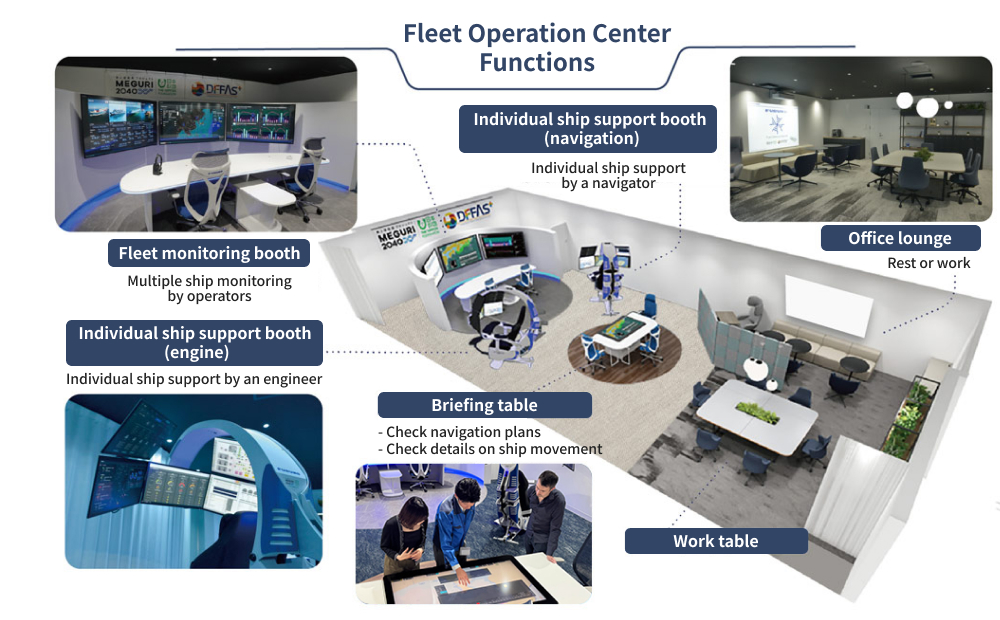
This Fleet Operation Center contains world-first equipment that is able to support the remote navigation of multiple ships. In the verification experiment slated to start next year, it will support the navigation of four ships simultaneously and remotely.
──When autonomous navigation is achieved, how will that change marine transport?
Kojima: I imagine it will change in all sorts of ways, but the thing I want to change the most is the working conditions for people involved in marine transport. It goes without saying that the crew members have to work extremely hard because the ship is in operation 24 hours a day, but the people who manage ship operations also need to be on standby 24 hours a day in case of an emergency. Moreover, in the current work environment, frequent schedule changes make it hard to make plans in your private life.
The marine transport industry is facing an aging workforce and high turnover rates. My hope is that by making work smarter across the entire marine transport industry, it will become easier to attract new people to take on ship careers.
Changing work conditions within the fishing industry with stationary net monitoring
──In what ways is DX occurring for people in the fishing industry?
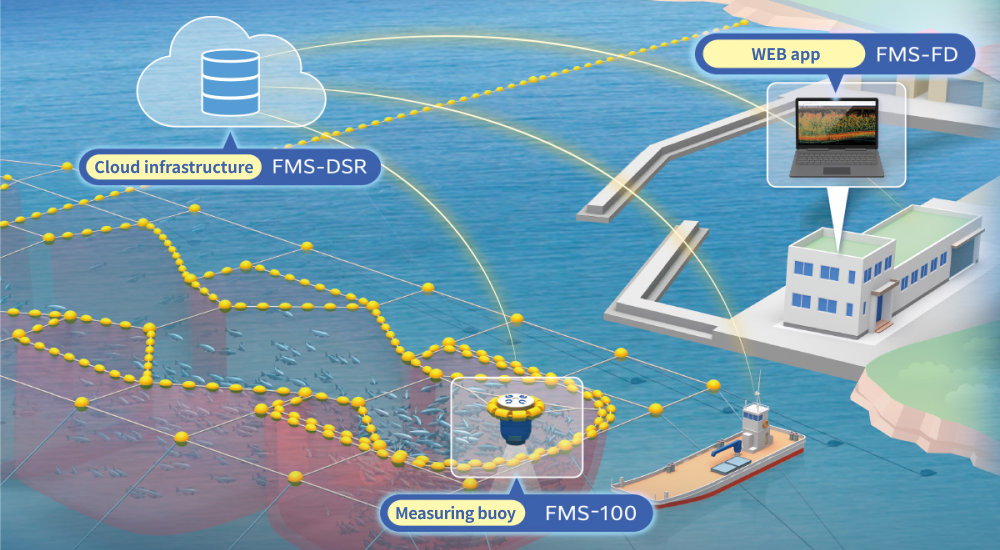
Hazama: The fishing industry is increasingly becoming "smart" through the use of information technology. For example, in February 2025, supply started for the stationary net monitoring system we developed. This is a system that can monitor fish caught in stationary nets in real time, from the land.
──How is stationary net fishing done without this system?
Hazama: The entire process revolves around simply not knowing what is in the net until you pull it up. Of course, it is possible to go out and look in a two-person fishing ship for example, and check the conditions of the waves and if it seems like fish might be in the area, but there is no way to assess what is going on deep underwater. If you can monitor from the land, not only will operation become more streamlined and working conditions improve, I also believe that analyzing data collected in the cloud will lead to realizing a sustainable fishing industry, including having a more detailed understanding of fishing industry resources and being able to forecast alterations in hauls resulting from climate change.
──How is DX being implemented in the fish farming industry?
Hazama: In January 2024, we released a fish weight estimation camera that is lowered into the habitat and the Aqua Scope app that can assess growth trends of farm fish by analyzing the data collected from the camera.
To fish farmers, body weight management of the fish they have raised is extremely important. They want to ship fish at the exact moment they can sell them for the highest value, and if their assessment is late, drastic losses can occur from things like feed costs. Up to now, farmers sampled through a method of catching fish and measuring their weight. But now, if they introduce this system, they can realize appropriate fish farming management without damaging their precious product.
Leading DX collaboration and energizing the entire industry
──What do you want people to look forward to from the DX Promotion Department?
Kitamura: The strength of FURUNO is our long-standing supply of products like nautical instruments and fish finders. Our products have been installed on ships to fulfill the function of the user's eye in the ocean. And I believe it is this track record which allows us to advance the DX of marine transport and the fishing industry in an integrated way with a knowledge of what is actually needed where the action is happening.
Currently, we also provide the Furuno Open Platform (FOP), a data collection system for ship operation support that views ships and the land as a single unit.
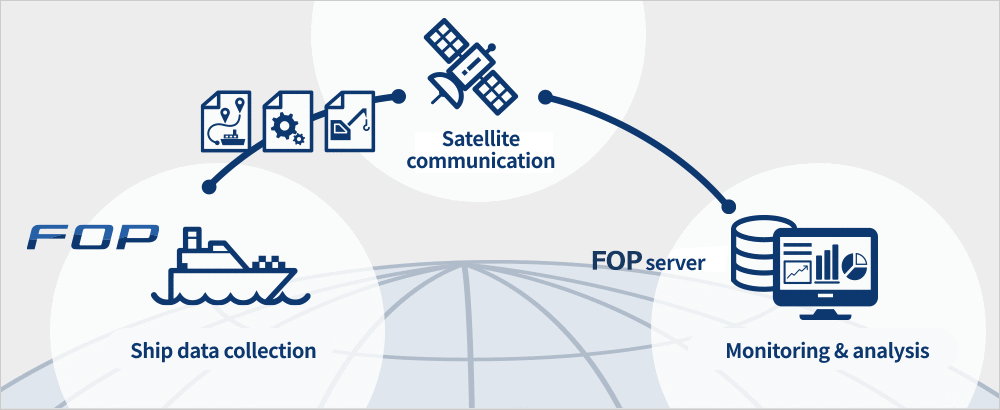
In an era where DX promotion is inevitable, every manufacturer is seeking new technological innovation through digitalization. In that environment, we want to share data collected through FOP with other manufacturers and collaborate with them in creating new technology through FOP.

──What kind of collaboration are you doing, specifically?
Kitamura: With Terasaki Electric, which excels at handling ship engine information, we are collaborating through system and service integration. The Terasaki Electric data collection platform TMIP collects data for areas including navigation, the engine, and alarm and event history, and the FURUNO FOP Cloud provides various kinds of cloud service like the FOP Shore viewer.
I feel that manufacturers collaborating to start something new like this is an extremely revolutionary action within the industry as well.
──People working across company lines need to join hands and invigorate the entire industry.
Kitamura: That's right. It is of course important to develop our own technology and compete with other companies, but our belief is that first, we want to energize the entire industry through collaboration.
If we do not actively partner together and share wisdom, there is a risk of the industry itself shrinking. Sharing data to create new business and technology and pushing the industry back into a posture of growth—that is the future we want to aim for.