20255.15
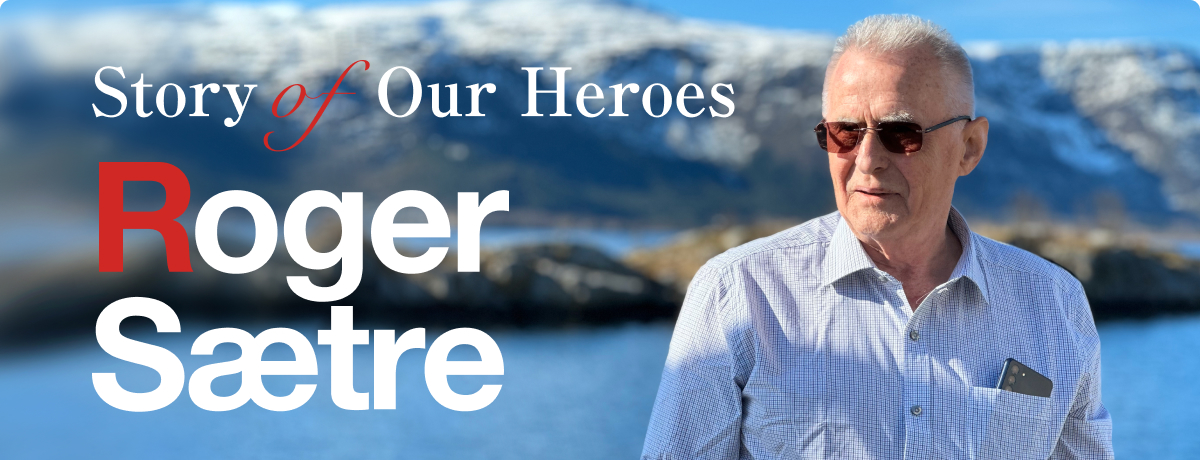
Norway is a global powerhouse in the fishing industry, and this is the story of one legendary Norwegian who helped elevate FURUNO’s marine technology to the world stage.


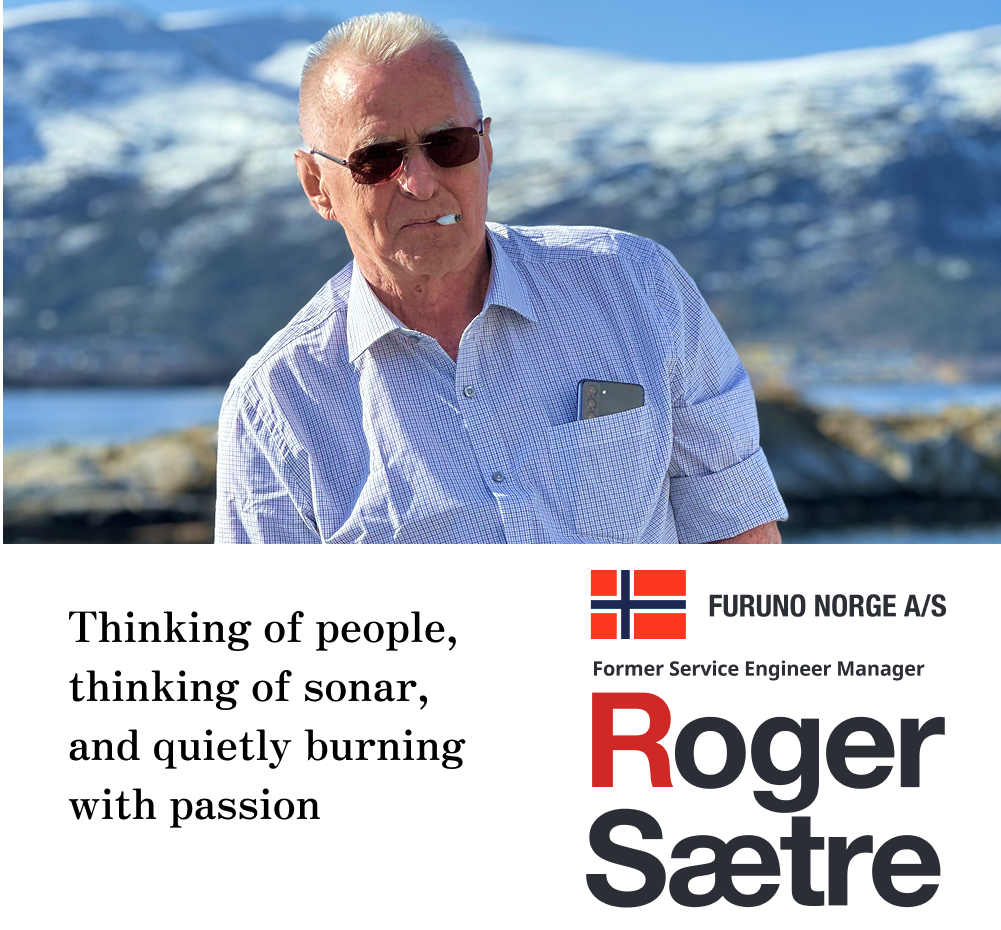
Norway is a global powerhouse in the fishing industry, and this is the story of one legendary
Norwegian who helped elevate FURUNO’s marine technology to the world stage.
Roger Sætre is a name that carries immense weight among the skippers and owners of large fishing
vessels, not just in Norway, but across the entire region. His reputation for expertise is so strong
that even competitors have been known to seek his advice and business, even while he remains a
dedicated member of the FURUNO team.
How did Sætre earn such unconditional trust? The answer lies in a story that defines his legendary
status. Through a series of interviews, we set out to discover the man behind the legend.
Shaping a New Era for FURUNO through Dedication and Expertise
Sætre grew up in a coastal community near Ålesund, Norway, surrounded by the fishing traditions of the North Sea. As a student, he developed a deep fascination with wireless communication, which led him to study electronics in the Royal Norwegian Air Force. After completing his military service, he joined a local marine equipment dealer, where he quickly earned the trust of skippers with his unwavering commitment to solving their problems. His reputation grew so quickly that the president of Furuno Norway’s predecessor made several attempts to recruit him.

in the Royal Norwegian Air Force starting at the age of 18,
he learned about aircraft electronic equipment such as wireless technology.
At the time, Sætre saw room for improvement in the reliability and support offered by other
manufacturers, and he was increasingly drawn to the potential of FURUNO’s technology. He
believed that FURUNO products were better designed from a fisherman’s perspective, and he
officially joined Furuno Norway in 1982, shortly after its founding.
He approached every task with a total commitment to the customer, often pushing for improvements
in both service and product design. Working long hours and often continuing his research late
into the night, he meticulously documented performance data in the field to help develop better
tools for the fishermen. Sætre reflects on those early years in his own words:
FURUNO has a sense of freedom that allows you to work on what you want to work on.
It is
a workplace where you can actualize what you want to do.
Researching sonar and fish finders, boarding fishing vessels and
learning how to operate
electronic equipment by observing,
and getting ideas in discussion with customers was a very valuable experience.

Sætre still spends his days studying and researching
in front of equipment in his own home.
One story in particular illustrates the level of mastery Sætre achieved through his years of
dedication. On one occasion, a Norwegian vessel equipped with a scanning sonar suffered a
display failure that was severe enough to normally require flying in experts from the head
office in Japan. But the vessel couldn't wait.
Sætre boarded the ship and worked through the night, pinpointing the cause as interference from
sea-bottom reflections. By fine-tuning the system’s menu settings, he was able to resolve the
issue entirely. This breakthrough was only possible because Sætre spent nearly every day on the
water, testing and understanding the equipment’s nuances. Whenever sonar issues arose across
Europe, Sætre shared his findings with colleagues across FURUNO’s global network, helping to
resolve countless technical challenges. This not only earned him the respect of technicians
worldwide but also played a pivotal role in establishing FURUNO's world-class reputation in
sonar technology.
Bridging the Gap: Bringing the Voice of the Field to FURUNO
At one point, a competitor launched a "spherical sonar" that promised total 360-degree
visibility, claiming to eliminate all blind spots. It was a major challenge for the
industry.
In response, FURUNO Director Ishihara (then CTO) led an R&D team to develop a sonar that could
provide even greater detection range. Leveraging high-precision ultrasound and signal processing
technologies originally developed for medical diagnostics, they created the FSV-24. This
360-degree scanning sonar offered a detection range of 6,000 meters—1.5 times the industry
standard at the time.

the verification experiment for the low-frequency
sonar FSV-24 aboard a ship (ZETA).
The skipper proclaimed,
"Sætre was aboard the ship more than the ZETA crew!"
(From left to right: the ZETA Skipper, Asaumi
(current DX Promotion Department Deputy Chief),
Ishihara, and Sætre)
A key challenge in long-range detection was noise elimination, but the team solved this using
signal processing technology with auto-filters, which is still a cornerstone of our technology
today. The FSV-24 surpassed the competition and became a global hit. Most of the developers
involved agree that Sætre played a crucial behind-the-scenes role in this success by connecting
the R&D team directly to the skippers’ needs. To accelerate development, FURUNO took the unusual
step of sending several engineers from HQ in Japan to Norway.
Sætre was obsessed with making the interface intuitive. He held his ground, refusing to
compromise on the echo display. Even as the final design was being set, Sætre requested a
complete overhaul of the screen layout, insisting, "This interface will
be too difficult for skippers to use in the field."
Ishihara initially resisted, noting, "This will delay the launch by two
full months. Given the urgency of the market, are you sure about this?" Sætre’s confidence
never wavered: "It must be changed." His conviction came from his deep bond with the
skippers and his countless hours spent on their vessels.
Managing Executive Officer and CMO Waimatsu later praised him, saying, "No one at FURUNO has spent more time on customer vessels than
Sætre."
Because of Sætre’s insistence on user-centric design, skippers today remain fiercely loyal to
FURUNO, knowing the equipment was built specifically for their needs.

the ZETA during the verification experiment
for the color scanning sonar FSV-30.
The technology achieved here is still in use today.
(From left to right: the ZETA skipper, Sætre,
and Nishimori (currently a Fellow))
Ishihara appraises Sætre as follows. "He is not swayed by customer opinion alone. He has his own ideas on what should be done based on digesting all sorts of information, and he communicates that logically and clearly. This is something you cannot do unless you have a better understanding of both the customer and the technology." This must be one reason why Sætre has earned absolute trust from all sorts of technicians.

Okunishi (currently Head Researcher), who is a long-time acquaintance of Sætre, requested help from him during the development of 3D sonar in 2016 as well.
"We employed many of Sætre's ideas that were based on the customer perspective, including areas like the operation menu and image display.
He contributed greatly to the widespread use of our sonar technology, including playing a key role in the creation of the F3D-S sonar visualizer that captures fish schools in three dimensions," said Okunishi in gratitude. (From left to right: Okunishi, Sætre, and Herman, Sætre's dog at the time)

in recognition of his achievements at FURUNO (Sætre is in the center of the front row in the photo, fifth from the right)