20257.25
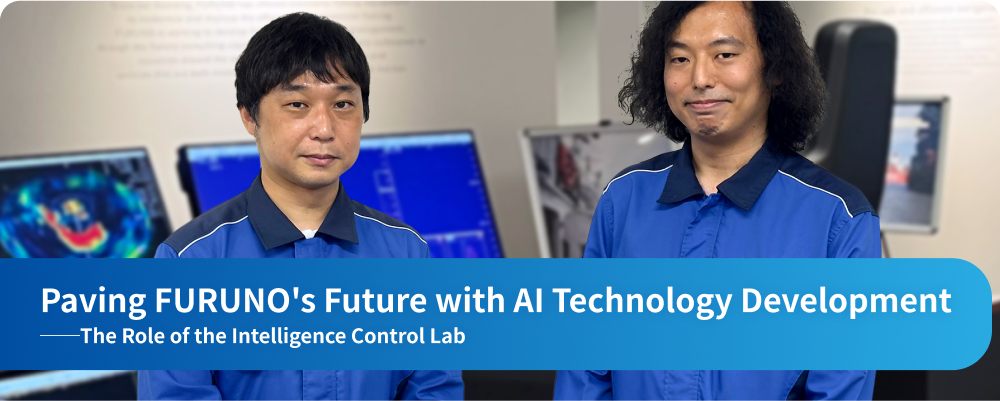
FURUNO AI Research Team Members Discuss the Technological Development History and Future Potential of the Intelligence Control Lab.


The FURUNO Technology Lab houses the Intelligence Control Lab, which is in charge of developing technology that uses AI. The AI research team launched in 2022. We asked the two founding members to reflect on the history of the Intelligence Control Lab, including the technologies it has developed and the motivation for that development. We also asked them to share their vision for the future.
Contents
To challenge the invisible, and beyond
──Why is it necessary to develop AI technology?
Kimura:During the period of rapid economic growth, the fishing and shipping industries both grew as more ships were deployed and more people were hired. It was, in essence, an era driven by sheer volume. For example, in the fishing industry, changes in the global environment have altered ocean currents and water temperatures, leading to a decline in catch quantities. Additionally, labor shortages have made it impossible to continue using traditional methods. To efficiently advance business operations with limited personnel and resources, sensor technology that can visually map out the imperceptible is essential, along with technology that anticipates the next step along the way.
The desire to actualize this is a driving force behind the FURUNO business theme of “Challenge the Invisible, and Beyond. ”The use of AI technology is indispensable for performing advanced predictions involving the complex interplay of diverse factors such as the marine environment, weather, and vessel conditions. We want to harness the power of AI to deepen the connection between people and the sea.
Okamoto:AI is not only essential for predictive technology, it is also needed to develop current technology to a higher level. Thanks to AI technology, ideas that were previously abandoned are now possible. There is a tangible sense of possibilities expanding.

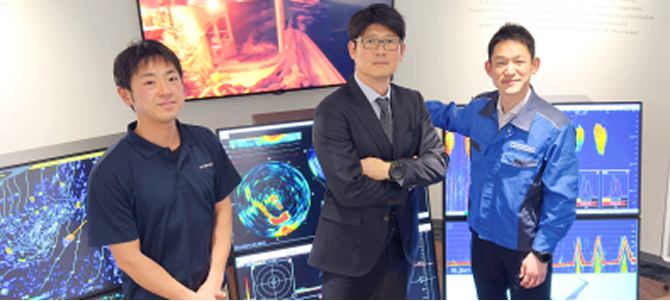
(Left) Intelligence Control Lab Director Konobu Kimura, No. 1 Research Department, Technology Lab
(Right) Intelligence Control Lab Chief Shin Okamoto, No. 1 Research Department, Technology Lab
──What kind of technology have you developed thus far?
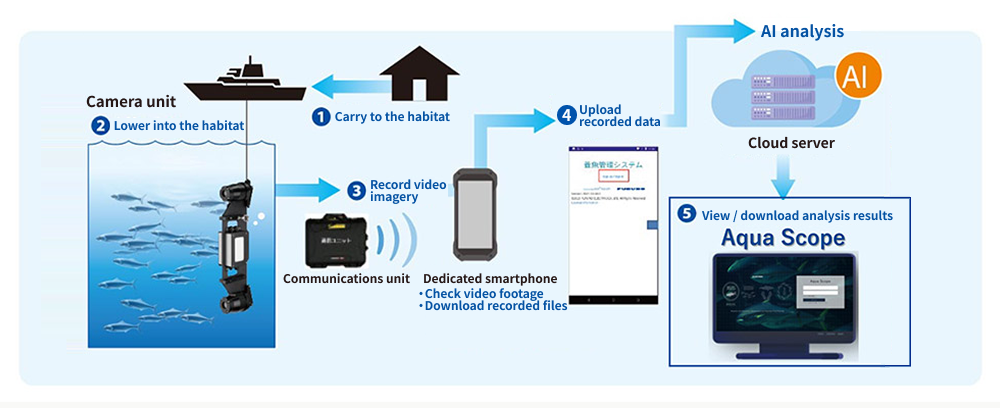
Kimura:When the research team first launched, we addressed onsite issues. In collaboration with the Aquaculture Support Business Promotion Office (now the DX Promotion Department), we meticulously examined each feasible AI technology-driven idea to address challenges in fish body measurement at aquaculture habitats. This led to the practical implementation of Aqua Scope, a system that monitors fish within aquaculture habitats through image recognition.
Okamoto:Technology utilizing LLMs (Large Language Models) like ChatGPT is also emerging. Using people to interpret the vast amount of navigation data collected onboard takes a significant amount of time. If we could train AI to learn the necessary knowledge and convert it into an interface that people can easily interpret based on the situation, it would significantly reduce the navigator's workload. We are attempting to create this kind of LLM technology that can provide that navigator support.
──AI support can help reduce the burden on people, right?
Kimura:Yes. Steering a ship is demanding work. While checking various equipment, you must also visually scan for obstacles and, if operating a fishing vessel, search for schools of fish. AI acts as an intermediary between the sea and people. We want to create technology that connects people with the ocean like that.
Academic conference presentations pave the way for ocean-land collaboration
──What kind of presentations did you make at the May meeting of the Japanese Society for Artificial Intelligence?
Kimura:In my oral presentation, I discussed the sea state simulation model being jointly developed with the Japan Agency for Marine-Earth Science and Technology (JAMSTEC) and the ultra-high-speed fluid analysis simulation technology for ship analysis that uses AI.

──By 'fluid,' do you mean the seawater that surrounds ships?
Kimura:Yes. Ships are massive objects, making sudden stops or sharp turns difficult. Therefore, when navigating, it is necessary to anticipate the environment along the navigation path in advance. In that process, the interaction with the fluid around the ship, which is seawater, significantly contributes to propulsion performance. To predict a ship's propulsion performance with high accuracy, technology that can simulate fluid is indispensable.
The relationship between the ship and fluid is extremely complex, and using conventional computational methods that solve all of the equations is time-consuming. What we developed and presented at the conference are computational models that use AI technology to perform lightweight alternative calculations to replace these complex physical computations (this approach is also referred to as a surrogate model in the industry). This technology can now perform calculations approximately 250 times faster while maintaining the same level of accuracy as conventional models.
At this conference, we also presented our joint research with JAMSTEC on ocean state simulation. Using an approach similar to the AI technology I just mentioned, we achieved computational efficiency that enables a full day's prediction for the entire global ocean to be executed in under one minute. This allows us to obtain results without requiring supercomputers like the Earth Simulator.

Kimura:The talk was packed to with so many attendees, the audience spread beyond the venue space. What was particularly interesting was that we were approached by organizations involved in land-based mobility technologies, like automotive companies. While the conditions and challenges of the sea and the land environments are significantly different, talking with these people revealed a surprising amount of commonalities. At our core, we share the same fundamental issues. Cross-disciplinary collaboration also has the advantage of making information exchange easier, as the parties involved are less likely to be pressured to compete against each other. While our primary focus remains on the ocean, I feel that presenting at academic conferences like this one helps broaden the scope of our linkages.
Okamoto:I also experienced many interesting encounters while attending the corporate exhibitions. And I also enjoyed the opportunity to learn about many different kinds of technology from the presentations of other people. All of FURUNO's labs actively participate in academic conferences.
Kimura:That might be because FURUNO likes producing world's first technology. I think many of our employees share that spirit of attending academic conferences to pioneer new markets.
Cultivating engineers and sales representatives who can effectively utilize AI
──The Intelligence Control Lab focuses not only on development, but also on cultivating AI staff within the company. What is the reason for this?
Okamoto:At the basic level centering primarily on using AI technology, it can be mastered in a relatively short period compared to other specialized technologies. However, for example, it's difficult for AI professionals to learn technologies which are new to them, like radar or sonar. So instead of taking that route, we can achieve a wider range of potential of AI applications if employees who have already amassed technological knowledge at FURUNO over the years start learning AI technology.
Not everyone needs to become an AI expert, but I want people to reach a point where they grasp what AI can do and how far they want to immerse themselves in it. It is predicted that the AI market will surpass the software market in the near future. Given that, we will need as many AI engineers as we currently have software engineers within the company. That is our current target for now.
Kimura:To generate innovation with AI, you need to understand not only AI technology, but also FURUNO technology and the industry. Those three elements are absolutely necessary groundwork for innovation to materialize. Currently, that is the cycle that we are beginning within FURUNO.
──What kind of AI training are you promoting specifically?
Okamoto:The first step we took was to hold several sessions with management-level personnel such as department heads and section chiefs to help them understand what AI can do. We discussed the characteristics of AI, and cautionary points.
We also run an AI Dojo where employees bring in work-related problems and we solve them together using AI. I myself have developed AI technology skills in the process of actual development projects. Based on that experience, I'm actually tackling AI development. When I encounter something I don't understand, I just learn as I go.
──What kind of results has the AI Dojo produced?
Okamoto:The Dojo operates on a six-month cycle. Currently, the second term has just begun. All members from the first term are already advancing implementations of AI technology in their respective fields. Some employees have stepped up to become in-house instructors. We're seeing the results we anticipated. Namely, once the initial hurdles are overcome, the program can run on its own.
When members of the Technology Development Department can solve their own problems using AI, FURUNO technology development will jump forward significantly. Additionally, we plan to have employees from areas other than the Technology Development Department learn AI as well.
For example, if sales representatives on the front lines can use AI to solve problems that arise in the field, new technologies will emerge in quick succession. People in the Research and Development Department are inevitably far from the field, making it difficult to quickly get a feel for the solutions that are needed. By having employees learn AI companywide, we believe innovation will emerge from all sorts of different angles.

The FURUNO culture of encouraging specialist participation
──How do you two feel about being responsible for AI technology development at FURUNO?
Kimura:In my previous role, I was involved in the development of medical equipment, and I worked with AI technology there. AI knowledge and technology are in demand across all fields. Just as I was looking to challenge myself in a different area, I had the opportunity to join FURUNO.
The field of maritime DX remains an unexplored blue ocean. There is much to be done, and it is highly rewarding. FURUNO possesses technology and experience accumulated over many years, as well as a vast amount of data. Furthermore, by utilizing our currently operating cloud service FOP, we can aggregate all ocean data. When you start thinking about all the ways this could be used, the possibilities are endless. I feel this is a truly fascinating field.

Okamoto:I conducted wireless research at university, so I joined FURUNO as a place where I could utilize that expertise. I was personally interested in AI technology, so I volunteered to participate when a dedicated AI team was established within the Intelligence Control Lab. I was not originally well versed in AI, so I learn as I go, but it has been incredibly rewarding. As Director Kimura says, there really is a lot to be done in this field.
──Having a lot of things needing to be done must be a technology developer's dream.
Kimura:Absolutely. In fields that have already leveled out into maturity, there is not much room for engineers to engage in new development. At FURUNO, engineers work with a spring in their step. If I had to describe my impression of FURUNO in one phrase, it would be “the samurai of technology.” In many companies, as employees age, they often move away from the field to management or other departments. At FURUNO, however, managers at the section chief and department head levels remain on the front lines of research and development, engaging in direct discussions.
Okamoto:I feel a strong sense of a corporate culture that is sincerely devoted to research and development. I am truly grateful to be able to work in that kind of an environment.

Respecting the ocean and growing together
──How do you think AI will change the ocean?
Kimura:FURUNO upholds the principle of respecting the ocean. In the past, humans have exploited and dominated the ocean. But moving forward, we must think about coexisting with it to our mutual prosperity. AI will become a powerful means to bring us closer to that future.
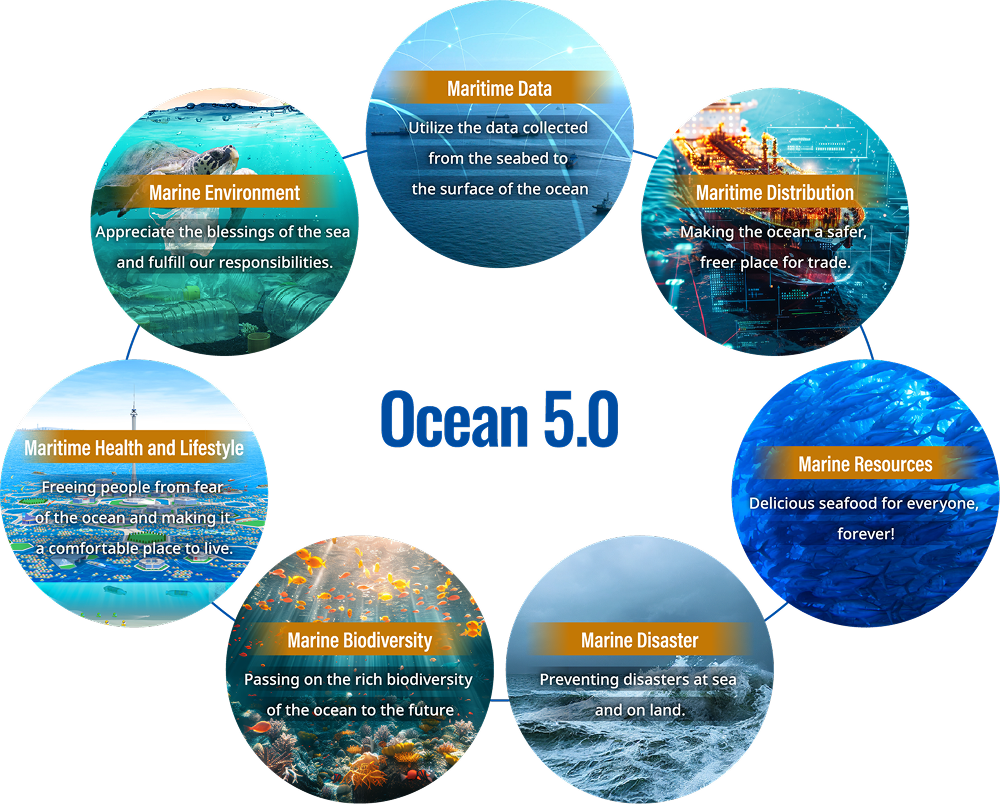
For example, if AI enables efficient automated navigation, it will reduce fuel consumption and lead to more environmentally friendly shipping. I also believe that AI can achieve things like those shown in the figure below.
Obviously, these achievements cannot be accomplished through AI alone. The human component is also essential. We want to continue tackling social issues like the global environment through cross-sector collaboration with diverse companies and organizations, pooling our collective wisdom.