20259.1
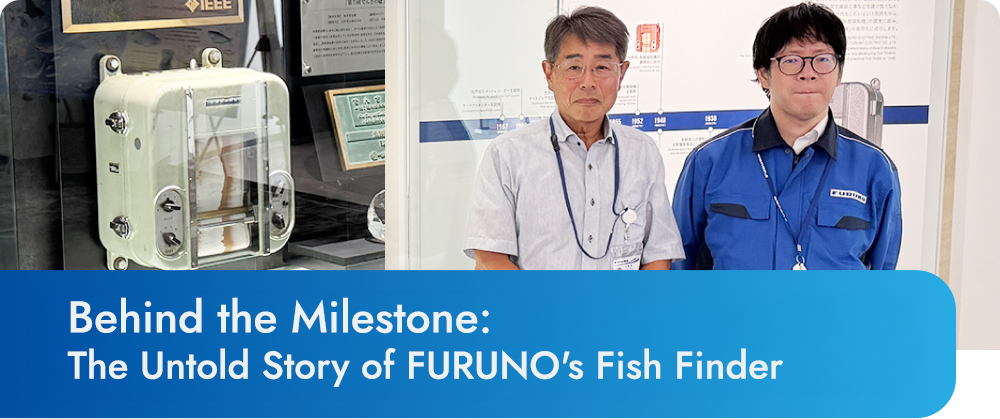
Fish finder, first commercialized by FURUNO in 1949, received IEEE Milestone certification. We asked the two individuals who worked tirelessly toward certification of this technology which has contributed to humanity to share the untold story of its development and its future potential.


The IEEE Milestone honors achievements that have made a lasting mark on the history of science and technology worldwide. The Milestone is a distinction bestowed by the Institute of Electrical and Electronics Engineers (IEEE), the largest academic society in the field of electronics engineering, and is reserved exclusively for technologies that have provided long-term and universal value to humanity. FURUNO's fish finder was added to this legacy of awards in 2025, joining innovations that changed history such as electrical communications, computers, semiconductors, and the internet. This technology was first commercialized worldwide in 1949, upon which it revolutionized the fishing industry. It since went on to garner international recognition.
In this article, we spoke to the two individuals who worked tirelessly toward certification. The fish finder technology would become the foundation of FURUNO, and we asked them to look back on its development journey, and to share their thoughts on how to carry it forward into the future.

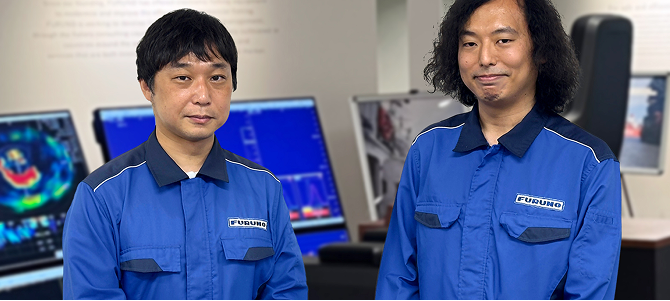
(Left) Takeshi Fujii, Intellectual Property Department, Technology Lab
(Right) Dr. Yasushi Nishimori (Fisheries Science Ph.D.), Fellow (Sensing Technology and Industry-Government-Academia Collaboration Supervisor)
Recognition of the invention that fundamentally changed the fishing industry's methods
──What was it about the fish finder that was recognized by the IEEE?
Nishimori:I believe the primary reason is that this invention revolutionized the fishing industry's methods, which had previously relied solely on intuition and experience. The more I look into it, the more I get a real sense of just how groundbreaking it was. In 1949, amid the societal challenge of postwar food shortages, it increased the supply of marine resources. Furthermore, as reflected in the IEEE Milestone recognition criteria, which require milestones to be, “a significant contribution to the advancement of society or industry over a period of 25 years or more,” the fish finder has supported the subsequent development of the fishing industry and remains an indispensable technology to this day. In short, it can truly be considered a technology that changed the world.
Fujii:I believe it was also recognized for its impact on the world. Kiyotaka Furuno, founder of FURUNO and developer of the fish finder, set his sights on the global market early on, championing the vision of “FURUNO for the World” He conducted inspections to confirm that the entire global fishing industry shared the same problems as Japan, and started exporting fish finders just seven years after commercializing them.
Even today, FURUNO maintains the world's top market share in fishing equipment, including fish finders. And even after more than 75 years since it was first developed, its immense influence can still be felt.
──Why was FURUNO able to pioneer development ahead of the rest of the world?
Nishimori:At that time, FURUNO (then named Furuno Electric Industries) was a small company with seven employees, centered around founder and developer Kiyotaka Furuno and his younger brother Kiyokata. I believe the reasons we were able to commercialize our product ahead of other rival companies even given our small company scale was that during our ongoing development process, we listened to the fishermen, rode along with them on their fishing vessels, and thoroughly immersed ourselves in the field. Kiyokata explained this approach as both a field-based approach and a philosophy of believing that "answers are found in the field." In other words, the seeds of new technology are in the field.
Fujii:Reading company history and records from that time, one is also struck by the sheer passion he had as an engineer. The desire to bring science to the fishing industry, coupled with the tenacity to work towards absolute completion no matter what for any method he thought would achieve this, are what ultimately led to success.
Nishimori:Engineers are creatures who, once inspired, absolutely must bring their ideas to life, so I myself understand that feeling all too well. At the time, people involved reportedly said things like, “It's impossible to see fish in the ocean,” and his prototype would malfunction, causing fishermen to react negatively. Even so, he and his employees repeatedly refined their work, rode in fishing vessels, and endured seasickness while they persisted with their experiments. I truly admire their dedication.
-
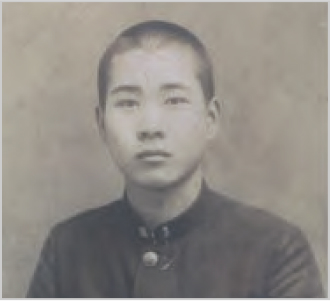
Kiyotaka Furuno -
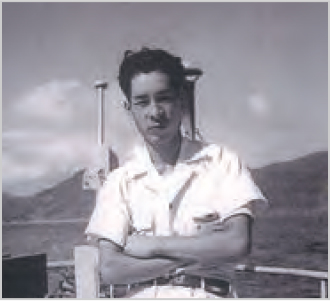
Kiyokata Furuno(about 1951) -
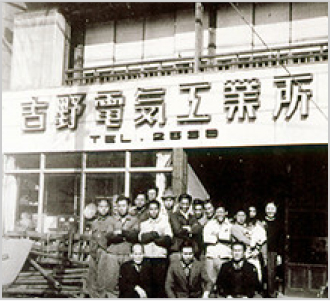
Furuno Industries, Ltd. in Nagasaki(Kiyotaka Furuno is in the center of the front row) -
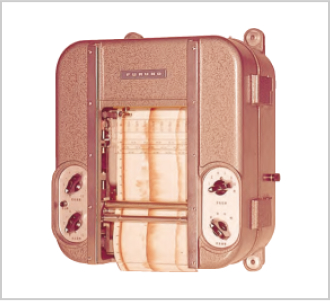
Production model of fish finder


Digging up every shred of evidence to substantiate the achievement
──I have heard that you, Mr. Fujii, went to great lengths to apply for the IEEE Milestone.
Fujii:To be recommended to the IEEE, objective evidence that FURUNO invented and commercialized the fish finder was essential. Founder Kiyotaka is an outstanding inventor who held numerous patents. But, regarding fish finders, he was too busy with day-to-day operations to secure the fundamental patent.
According to company history, the fish finder was developed in the year 1948. But external records of this do not exist. What I took a look at next was an incident also recorded in company history. In 1949, a fish finder was installed on the Masutomimaru, which at the time had the lowest catch volume and was called a dud ship, and it recorded a large haul. It would have been helpful if sales receipts or anything similar proving that the large catch happened had been preserved. But, given that this happened over 70 years ago, no one could find any such records.
However, company history mentioned that the Nagasaki Shimbun newspaper (then known as the Nagasaki Nichinichi Shimbun) published an article about the large catch. So, I asked for information from the newspaper company. Someone at the Nagasaki Shimbun newspaper company went through old newspapers and found the article. This proved to be the key factor.
──If you had not found that newspaper article, you might have wound up not having any proof at all.
Fujii:That's right. This made me keenly aware of just how important it is to leave behind evidence. And I believe Kiyotaka felt the same way. After that, he filed numerous patents, and our company culture places a strong emphasis on intellectual property.
Nishimori:Compared to companies of similar sizes, I believe our Intellectual Property Department has a significantly larger number of patent attorneys. Just as it is important for university researchers to retain their research results in the form of academic papers, it is important for corporate research developers to retain their results in the form of patents.

The FURUNO company-wide celebration banquet
──When the certification came through, how did you feel?
Fujii:I was so deeply happy.
Nishimori:Well, Mr. Fujii, you definitely were the one who put in the most difficult effort to make the whole thing succeed. Actually, the notification of certification arrived the day before the farewell gathering for Kiyokata, who had been serving as an Honorary Advisor and who had passed away about two months prior. We had wanted this notification to arrive while he was still alive, but the strange timing of it coming the day before the farewell gathering made it feel as if it was a gift from him.
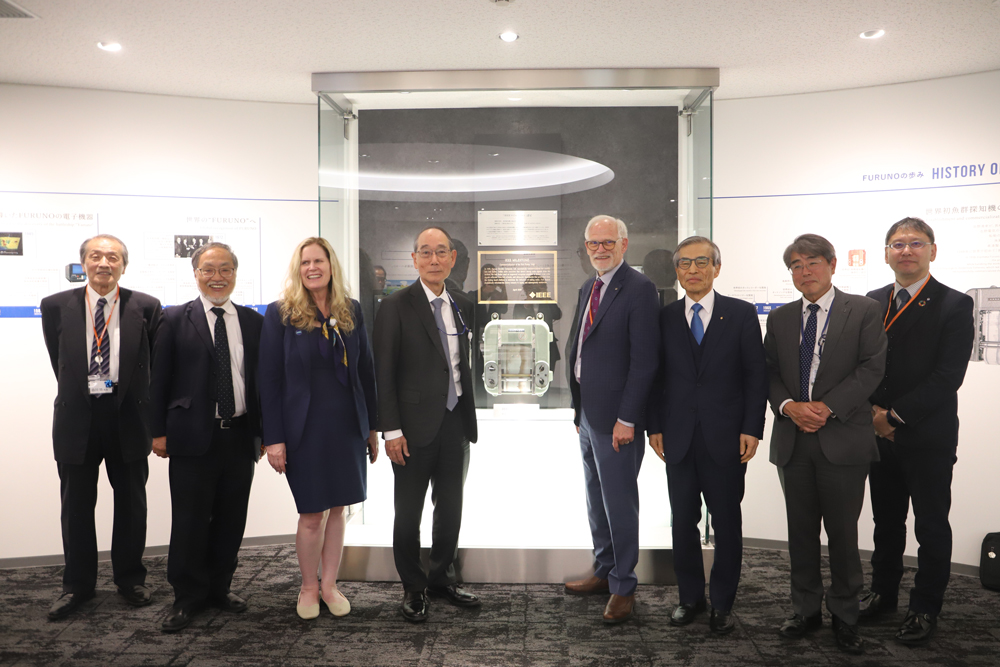
──The IEEE Milestone Certification Presentation Ceremony was held at the FURUNO Headquarters in April.
Nishimori:An amazing gathering of unbelievably important individuals attended, including current IEEE Chairperson Kathleen Kramer, previous Chairperson Tom Coughlin, former Chairperson Toshio Fukuda, previous Osaka University Graduate School of Engineering President Shojiro Nishio, Vice President Takao Onoye, leading fish finder research authority Professor Masahiko Furusawa, and IEEE Fellows Professor Isao Shirakawa and Professor Tomohiro Hase, who both worked tirelessly for the certification. All employees assisted with the celebration banquet planning, and the live music was also performed by employees. I believe interacting with IEEE members provided valuable inspiration for our employees as well.
Fujii:All the effort we put into planning paid off, and I was truly delighted to receive positive feedback from attendees. People said it was a wonderful celebration banquet and it was great to interact with FURUNO employees.

Innovation begins with the actions of a single person
──How do you want to utilize this certification moving forward?
Nishimori:The founder's legacy lives on as the culture, philosophy, and fundamental guiding principles of FURUNO. This certification was a wonderful opportunity to remind everyone of this FURUNO DNA. I want the next generation to carry on this spirit and spark innovations that will lead to the next IEEE Milestone certification. This review of the development process was immensely inspiring to me as well.
Fujii:Dr. Nishimori, you continue to engage in research and development, and thoroughly apply the philosophy that answers are found in the field.
Nishimori:Well, I guess since I am an engineer, I just love getting out into the field. I have also been involved in overall management and business leadership, but for the past four years, I've held the position of Fellow. In this role, I'm able to develop the technology I like, working alongside younger colleagues to develop new fish finders and sonar systems. I have also dived into the aquaculture market as a new challenge, but it is very difficult... Hearing about fish finder innovation makes me so envious (laughs).
I believe that the initial spark for innovation to emerge is the actions of a single individual. At our lab, we often say, “Be a small drop in the large river,” but everything begins with the desire and passion of one person. It starts with just one person, and then more and more people join in. But that initial trail blazer is crucial.
Fujii:I think the ability to draw in other people was probably also immense back then. Just seeing someone trying so hard can make you want to see them succeed. There are many amusing anecdotes about the founder from back then. For instance, there was the story of Kiyotaka getting so engrossed in his thoughts while getting a haircut that he left without paying, forcing Kiyokata to rush over and pay the bill.
Nishimori:Passion, the technological skill to make that dream a reality, and the importance of documentation to protect intellectual property. These are the topics I want to speak about and pass down.
Fujii:That's right. There was much to learn from the Furuno brothers. It was a very enlightening experience, even from the viewpoint of the Intellectual Property Department as well.